

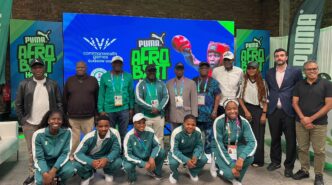

Persianas Retail Limited, PUMA’s official partner in Nigeria, opened the PUMA Afrobeat House at the 2026 Commonwealth Games in Glasgow on July 24, running for ten days as Team Nigeria’s official hospitality and cultural hub throughout the Games.
The space was not a branded booth or a product display. It was a physical recreation of Nigerian cultural energy inside a Scottish city: DJ sets, Nigerian food and drinks, entertainment, and a gathering point where athletes, delegates, families, and guests could connect and celebrate throughout the tournament.
NSC Director-General Bukola Olopade described the experience at a press conference held inside the Afrobeat House on July 29: “Our experience with PUMA as Team Nigeria’s official kit sponsors for the Commonwealth Games Glasgow 2026 has been very positive and progressive, and the Commission is ready for a long-term partnership.”Persianas Retail Limited CEO Ayo Amusan framed the significance from the brand’s side: “At PRL, this partnership is about standing behind the athletes who represent the very best of Nigeria.
We are proud to equip Team Nigeria with world-class performance gear as they prepare to compete on one of the world’s biggest sporting stages.”Team Nigeria finished seventh on the overall medal table with 24 medals, including nine gold.
What the Afrobeat House Changes About Sponsorship
Most sportswear kit deals look the same. A brand supplies uniforms and puts its logo on the athlete. The athletes compete. The brand gets broadcast visibility when the athletes win.
At the end of the tournament, both sides issue a statement about a successful partnership and go home.The PUMA Afrobeat House did something structurally different. It created a physical destination that made the sponsorship visible to people who were not watching the competition.
Athletes, their families, Nigerian delegates, diaspora supporters, and media representatives all passed through a space that was unmistakably Nigerian in character and unmistakably PUMA in branding.
The partnership was not just visible in the stadium. It was experiential in a dedicated venue for ten days.That distinction matters because it shifts the value of the sponsorship beyond broadcast impressions and into something closer to cultural association.
By building a space filled with Afrobeats music, Nigerian food, and the energy of Nigerian athletic achievement, PUMA positioned itself as a brand that understands and celebrates Nigerian identity rather than simply outfitting Nigerian bodies.
The Localisation Lesson
Global sportswear brands regularly partner with national teams. The challenge is that national team kit deals, as executed at most events, are interchangeable. The logo changes, the kit colour changes, but the structure of the partnership looks identical across markets.
A Nigerian team wearing PUMA looks like a Senegalese team wearing PUMA, which looks like a Jamaican team wearing PUMA. The brand is present but not differentiated.The Afrobeat House is differentiated.
There is no equivalent version of it for any other national team at Glasgow 2026. It is a Nigerian experience, physically located in Glasgow, built specifically around Nigerian culture and the achievement of Nigerian athletes. That specificity is the competitive advantage of the activation over a standard kit deal.
It is also worth noting that the Afrobeat House was built ahead of the NSC announcing its intention to pursue a long-term partnership with PUMA. The sequence suggests that the Afrobeat House was partly designed to demonstrate the kind of brand commitment that would justify a multi-year deal, rather than simply fulfil the obligations of the existing one.
What Nigerian Sports Sponsorship Could Look Like
Nigeria is one of the most culturally productive countries on the continent, with a music, fashion, film, and food culture that has genuine global reach.
The Afrobeat House is a demonstration of what it looks like when a sportswear brand treats that cultural identity as an asset to be amplified rather than a logistical challenge to be managed.
For Nigerian brands evaluating sports sponsorship, and for global brands considering deeper investment in Nigerian markets, the Afrobeat House offers a practical reference point.
The brands that build experiences around Nigerian culture rather than simply associating with Nigerian results will build more durable commercial relationships than those that show up with a logo and wait for medals.