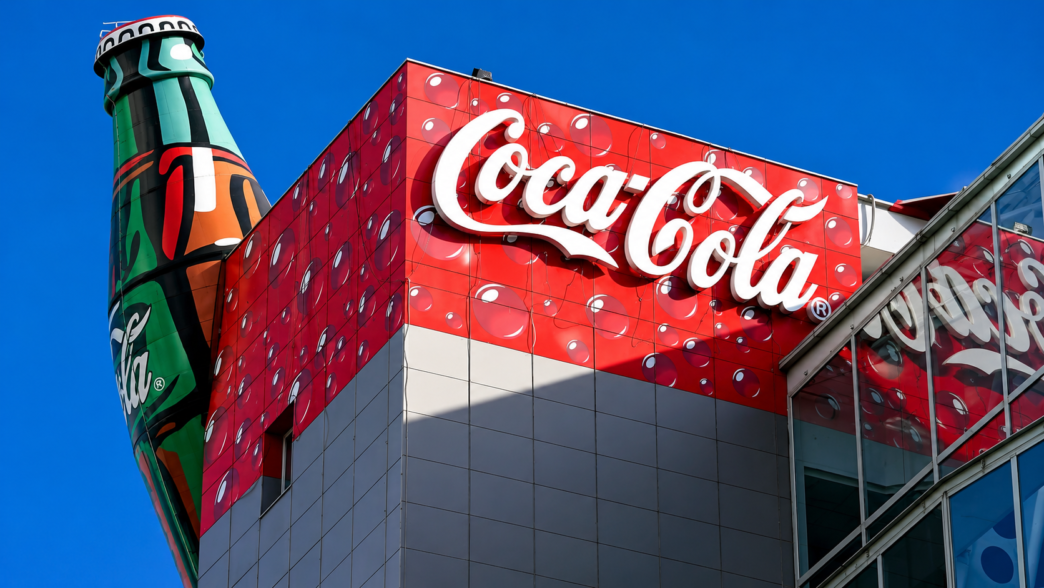
The Coca-Cola Company has unveiled a new global visual identity system, developed with branding agency JKR, rolling out across more than 200 markets in Latin America, Europe, the Middle East, and Asia.
The refresh does not replace the brand's most recognisable assets. It amplifies them. The bold red-and-white colour palette, the Spencerian script, the Dynamic Ribbon, and the Arden Square are all retained and made more prominent across packaging, retail environments, digital experiences, and equipment. Coca-Cola Zero Sugar receives its own distinction within the system, with larger typography, a black Dynamic Ribbon on cans, and black bottle caps on PET packaging.
The brief that produced the work was direct. Dave Balsamello, creative director at JKR, described the starting point: "The original brief was to create a platform identity for a new campaign. Pretty quickly, we all realised there was something bigger to solve. It had been nearly a decade since Coca-Cola had set standards for its brand.
Most guidance had been centred around individual campaigns or platforms, and because of that, there was a need for more consistency."
The Infrastructure Behind the Refresh
What separates this from a standard visual refresh is the system Coca-Cola has built to govern it. The company has introduced a new Brand Center, developed with Forpeople and Monks, giving internal creative teams and agency partners a single reference point for implementing the identity correctly.
Alongside it, Coca-Cola has launched Design Intelligence tools, built in collaboration with Adobe under the project name Fizzion, which use AI to encode brand guidelines into intelligent, adaptive assets that can be applied consistently across formats and markets.
Rapha Abreu, Global Vice President of Design at Coca-Cola, described the technology's role: "With Fizzion, our design elements become smart. Logos, type, imagery, brand guidelines now live intelligently inside them. Each asset understands how it should behave, adapt, and scale across any context. This is about embedding AI at the heart of our brand system so creativity can move faster, without losing its soul."
The system allows local markets to retain flexibility for cultural messaging and local activations while operating within a consistent global visual framework. Abreu likened the approach to "designing the operating system rather than every application."
Why Consistency at Scale Is a Hard Problem
Coca-Cola operates across more than 200 countries through a network of bottling partners, agency partners, and internal creative teams, all of whom must produce content that looks and feels unmistakably Coca-Cola regardless of language, format, or market.
Without a governed system, that produces drift. Campaigns start to look slightly different from market to market, pack designs begin to diverge, and over time the brand becomes inconsistent at the edges while trying to hold the centre.
The Design Intelligence toolkit addresses that problem structurally rather than just editorially. Instead of circulating a PDF of brand guidelines and hoping teams follow them, Coca-Cola has built AI-powered tools that learn from how designers actually work inside Adobe Creative Cloud applications and encode that creative intent into a machine-readable identity that applies brand rules automatically.
The result is a brand system that governs itself as it scales, which is a meaningfully different ambition from what most brand guidelines documents achieve.
What This Means for African Markets
The global rollout covers Latin America, Europe, the Middle East, and Asia as a starting point. African markets, including Nigeria where Coca-Cola has operated since 1951 and recently marked its 75th anniversary, will be covered under the system as the rollout expands.
For Nigerian and African brand teams working with Coca-Cola on local activations, the Brand Center and Design Intelligence tools will eventually provide the same governed framework that global markets are receiving now.
For Nigerian brands with growing footprints across multiple markets, the Coca-Cola model offers a useful reference. The tension between global consistency and local cultural relevance is one that every brand with pan-African ambitions will eventually face.
Coca-Cola's answer is to build the infrastructure that makes consistency the default rather than the exception, while preserving enough flexibility at the edges for local markets to remain culturally relevant.
That balance is harder to build than it sounds, and Coca-Cola has spent considerable resources figuring out how to do it at a scale most brands will never need to match.