

Tesla has never been content to build cars the way everyone else does. From its early electric sports car to its push for mass-market electric vehicles, the company has spent years challenging conventional ideas about transportation.
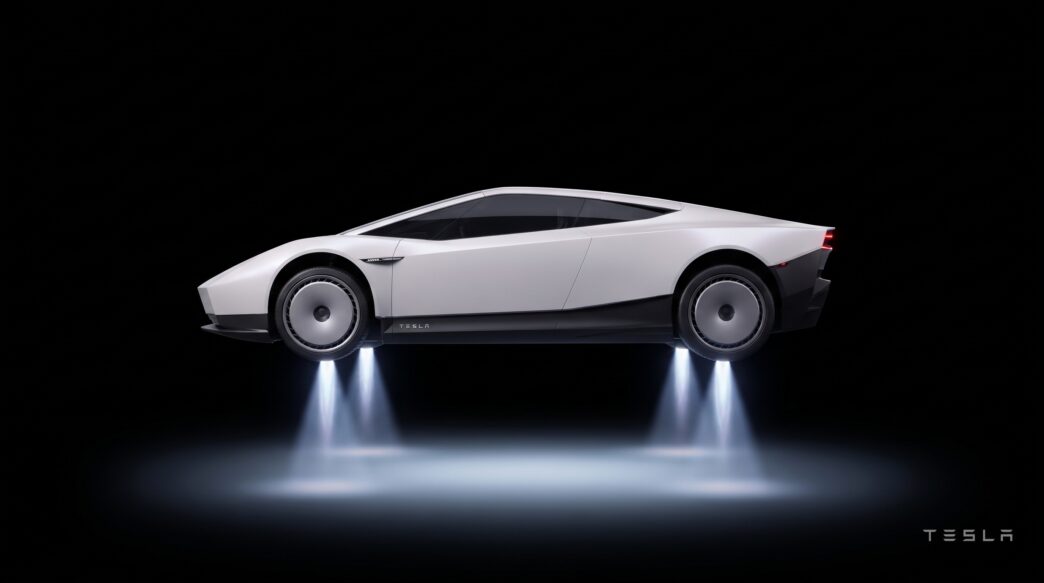
Now, Elon Musk wants to push those boundaries even further.The next-generation Tesla Roadster has been presented as an electric sports car capable of performing aerial manoeuvres using rocket-style thrusters developed with SpaceX.
During a demonstration in Texas, the vehicle climbed a ramp, travelled upside down using a suction system, rotated in the air and landed on its wheels.
Musk has also claimed that it could accelerate from zero to 60 miles per hour in less than one second.Tesla is targeting 2028 for production, although the Roadster has already endured years of delays.
The demonstration was dramatic. It also raised a more important question: is Tesla building the future of the automobile industry, or simply demonstrating how far technology can be pushed?
My view is that it is attempting both. The Roadster represents an ambitious effort to redefine what a car can do, but it also exposes the difference between imagining the future and delivering something people can actually use.
The Car Is Becoming More Than a Way to Travel
For decades, the purpose of a car was straightforward: move people and goods safely, reliably and efficiently. Manufacturers competed on price, performance, comfort, fuel economy and design.Technology has changed the terms of that competition.
Modern vehicles can connect to the internet, receive software updates, assist with parking and braking, and use cameras and sensors to interpret their surroundings. Electric vehicles have also reshaped expectations around performance, delivering rapid acceleration without a conventional petrol engine.
Tesla helped make electric cars desirable to consumers who did not want to see them as a compromise. Its original Roadster demonstrated that an electric vehicle could be a high-performance sports car, while subsequent models helped bring electric driving to a wider market.
The new Roadster takes that ambition to a more extreme level. It asks consumers to imagine a car that does more than drive fast. With rocket-style thrusters, it promises manoeuvres that would be impossible for a conventional road vehicle.
But a demonstration of aerial movement does not make the Roadster a practical flying car. Sustained flight, passenger safety, everyday usability and the ability to operate within existing transport systems are entirely different challenges. Those questions require technical evidence, not just an impressive showcase.
Nevertheless, the concept highlights how the automobile industry is evolving. Competition is no longer limited to engines, battery range and interior design. Software, computing power, automation and the overall driving experience are increasingly central to how manufacturers differentiate themselves.
Tesla understands the value of making people pay attention. Few product demonstrations generate the same level of curiosity as a car that appears to defy the limits of conventional engineering.
But attention is not the same as progress. The real test is whether a technological breakthrough solves a problem, creates a meaningful benefit or changes how people use a product.
Tesla's Biggest Challenge Is Turning Big Ideas Into Useful Products
There is a reason the Roadster has attracted so much attention. A car capable of jumping into the air sounds like something from science fiction. It gives Tesla an opportunity to showcase its engineering ambitions and reinforce its reputation as a company willing to attempt what others might consider impossible.
That ambition has value. Industries advance when companies test ideas that initially appear unrealistic. Research into batteries, vehicle control, autonomous systems and alternative forms of propulsion can generate knowledge that eventually benefits products far removed from the original experiment.
However, the automobile industry is full of ambitious concepts that never become practical, commercially viable vehicles. Building a working prototype is only one part of the process.
A manufacturer must also demonstrate reliability, safety, manufacturability and a compelling reason for customers to pay for the finished product.
The Roadster still has significant questions to answer. Tesla first announced the next-generation model in 2017, and its production timeline has shifted repeatedly. The latest target is 2028, but a target date is not a guarantee of delivery.
That history makes execution particularly important. Tesla must demonstrate more than another spectacular presentation. Prospective buyers need clarity on the final specifications, pricing, availability and practical limits of the vehicle's most unusual features.
Safety and regulation will be equally important. A vehicle that leaves the ground introduces risks and legal questions that conventional road cars do not face in the same way.
Any system involving aerial manoeuvres would need to demonstrate that it can operate within clearly defined safety limits and comply with applicable regulations.
A car is not used exclusively in controlled environments. It must contend with traffic, unpredictable road conditions and the presence of other people. Extraordinary capabilities mean little if they compromise reliability or create risks that outweigh their benefits.
This is where Tesla's broader record becomes relevant. The company has helped transform perceptions of electric vehicles, but its history of ambitious promises and shifting timelines makes it reasonable to demand proof of delivery.
Vision can attract customers and investors; execution is what ultimately sustains confidence.
The most valuable outcome may not be the creation of a flying sports car. It could be the engineering knowledge developed along the way, including advances in vehicle control, materials, software or other systems that can be applied to more practical products.
The aerial feature may generate the headlines. What Tesla learns from developing it could prove more consequential.
The Future of Cars Will Depend on More Than Flying
The Roadster raises a broader question about the direction of the automobile industry. Flying cars, autonomous vehicles and machines that navigate cities without human intervention make for compelling visions of the future. But transportation will not be transformed by spectacle alone.
For most drivers, the priorities remain practical. How far can a vehicle travel on a single charge? How quickly and conveniently can it recharge? Is it safe? What will it cost to maintain? Will its software work reliably? Can it handle the roads people actually use?
These are the questions that will determine whether new technologies reach beyond wealthy buyers and early adopters.
Electric vehicles still have substantial opportunities for improvement. Better batteries, lower production costs and more accessible charging infrastructure could make electric driving practical for more people.
Software can improve convenience and performance, but only if it operates reliably and does not introduce unacceptable risks.
Autonomous driving could also reshape how people use vehicles, provided the technology proves dependable in complex and unpredictable conditions.
Robotics may transform vehicle manufacturing and maintenance. These developments could have a more direct impact on everyday transportation than a sports car capable of briefly lifting off the ground.
This is not an argument against bold ideas. It is an argument for measuring innovation by what it delivers.
Tesla has the brand recognition and market position to influence how consumers think about the next generation of cars.
An extraordinary product can challenge competitors, attract engineering talent and expand the boundaries of what manufacturers attempt. But the company must also continue to deliver vehicles that meet real customer needs.
The balance between ambition and usefulness is difficult to achieve. A feature that looks extraordinary during a demonstration may become less appealing when buyers consider the price, practical limitations, safety implications and whether they will ever need it.
The Roadster could still become an important engineering achievement. Even if its aerial capabilities remain limited to specialised applications, the technology developed during the project may have wider value. But it is too early to treat the vehicle as proof that flying transport is about to become commonplace.
Nor will the future of the automobile industry be decided by Tesla alone. Established manufacturers and newer electric vehicle companies are investing in batteries, software, driver assistance and alternative vehicle designs.
Tesla will have to compete on the strength and reliability of its products, not simply the scale of its announcements.
Ultimately, the companies that shape the next era of transportation will be those that combine ambitious thinking with disciplined execution. They must show not only what technology can do, but why it matters, who it serves and whether it can be delivered safely and consistently.
Tesla has already changed how many people view electric cars. The new Roadster suggests that Musk wants to challenge those expectations once again.
Whether Tesla succeeds will depend on what happens after the cameras stop rolling.
For now, the Roadster is a glimpse of one possible future, not proof that flying cars are about to become part of everyday life. Tesla has demonstrated its willingness to attempt something extraordinary. Its next challenge is to prove that it can deliver.