


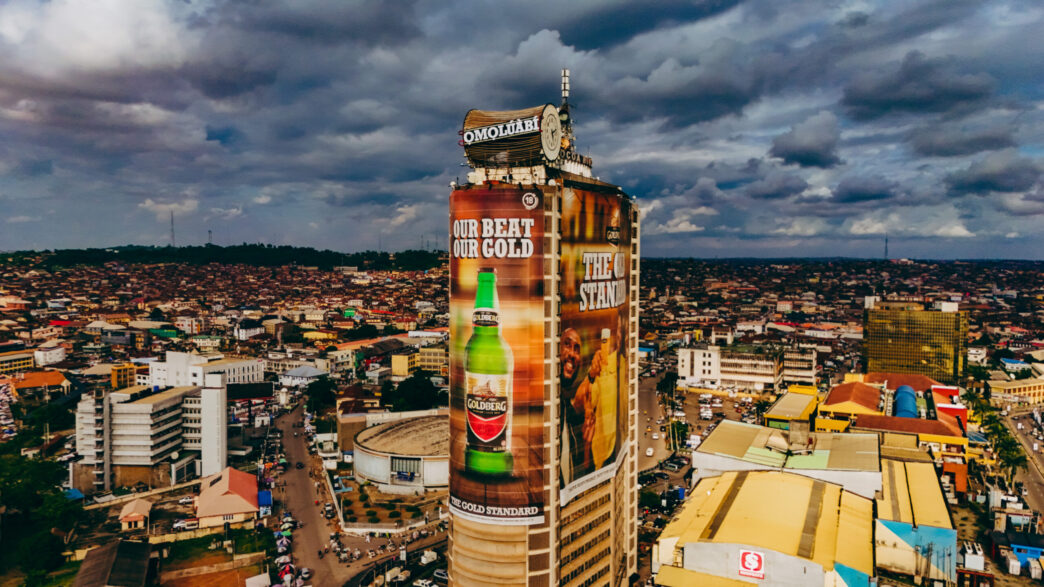
Goldberg Lager unveiled a monumental talking drum installation atop Cocoa House in Ibadan on August 7, 2026, as part of its "Our Beat. Our Gold." brand platform, with the drum activating every hour with a rendition of Omolúàbí, the Yoruba expression associated with good character, followed by the chime of the hour.
The location is the first reason the idea works. Cocoa House, completed in 1965 from the proceeds of the Western Region's cocoa trade, has stood for more than six decades as a symbol of indigenous enterprise, ambition, and economic achievement; the 26-storey building was also widely recognised as West Africa's first skyscraper when it was completed.
That gives Goldberg something most brands spend enormous amounts of money trying to manufacture: cultural meaning that already exists.
Why the Location Matters
A talking drum could have been placed almost anywhere in Ibadan and still communicated Yoruba heritage, but putting it on top of Cocoa House creates a much stronger connection because both objects already carry meaning independently of the brand.
The talking drum represents a historical form of Yoruba communication, celebration, and storytelling, while Cocoa House represents a period when indigenous enterprise was powerful enough to finance one of the most ambitious buildings on the continent; putting the two together creates a story about culture and ambition that fits naturally within Goldberg's wider brand platform.
Nigerian Breweries Marketing Director Sarah Agha described the installation as a lasting symbol of cultural pride rather than simply an advertising placement, while Odu'a Investment Group Chief Executive Abdulrahman Yinusa described it as crowning Cocoa House with a talking drum of Yoruba civilisation.
That distinction matters because the strongest cultural marketing does not simply place a brand inside a culture; it finds something within that culture that already carries meaning and gives it another reason to be remembered.
Why the Talking Drum Is More Than Decoration
The drum is not simply sitting on top of the building as a visual landmark. It activates every hour with Omolúàbí, giving the installation a recurring sound and turning the brand presence into something people can experience rather than simply see. That is an important difference.
Most out-of-home advertising exists in spaces that have little meaning of their own: a billboard on a highway, a digital screen in a shopping mall, or a poster at a bus shelter. The brand has to supply almost all of the meaning, which means the creative work has to do the heavy lifting.
Goldberg has taken the opposite approach. Cocoa House already means something to Ibadan, and the talking drum already means something to Yoruba culture; the brand has essentially connected itself to two existing sources of meaning rather than trying to manufacture a new one from scratch.
The hourly activation makes the association even stronger because repetition is one of the fundamental mechanics of brand building. Someone does not have to attend a Goldberg event or deliberately interact with an advertisement to encounter the installation; they can simply be in the city when the hour changes.
This Is Different From a Cultural Sponsorship
Nigerian brands have become increasingly sophisticated at cultural marketing, sponsoring festivals, supporting traditional institutions, creating experiential activations, and building campaigns around Yoruba, Igbo, Hausa, and other cultural identities.
Those strategies can be powerful, but most of them are temporary. The festival ends, the activation is dismantled, the campaign moves on, and the brand waits for the next cultural moment.
The Cocoa House installation changes that equation because it is designed to remain. Every hour, the drum creates another opportunity for Goldberg to become part of the physical and cultural environment of Ibadan; over time, that repetition can create an association that is considerably harder to achieve through a conventional campaign.
In that sense, the installation is closer to brand infrastructure than advertising.
The Real Value Is What Happens After the Launch
The launch naturally attracted attention, with Kunle Remi, Odunlade Adekola, BBNaija winner Imisi, and cultural and government stakeholders present, giving the installation the visibility required to establish the idea publicly.
But the launch is not the most interesting part of the strategy.The real marketing value begins after everyone leaves.It is the Ibadan resident who hears Omolúàbí at 10am, the visitor who notices the drum on the skyline, the person who shares a picture of Cocoa House, or the young consumer who encounters the installation repeatedly without ever attending a Goldberg event.
That is how cultural associations become durable. Not through one big campaign moment, but through repeated encounters that gradually make the brand feel like part of the environment it has chosen to represent.
Goldberg is therefore doing something more ambitious than putting a talking drum on a landmark. It is attempting to turn one of Ibadan's most recognisable structures into a recurring expression of the brand's relationship with Yoruba culture.
The question now is not whether people will notice the drum; they almost certainly will. The more important question is whether Goldberg can sustain the same level of cultural relevance across the rest of its brand activity, because the installation has established a very clear standard for what "Our Beat. Our Gold." can look like when the idea is allowed to live beyond a campaign.